
California Mileage Reimbursement Rules: What Employers Need to Know
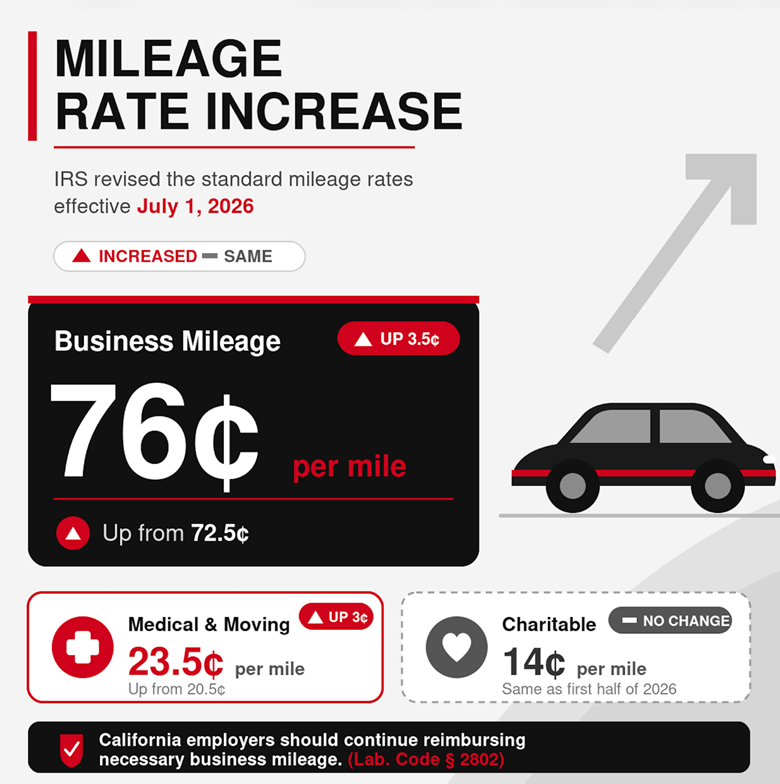
On July 13, 2026, the IRS released Internal Revenue Bulletin 2026-29, which increased its standard mileage reimbursement rates effective retroactively to July 1, 2026. The IRS cited recent increases in fuel prices as the basis for the change.
The revised rates are:
- 76 cents per mile for business use, up from 72.5 cents.
- 23.5 cents per mile for medical and qualifying moving purposes, up from 20.5 cents.
- 14 cents per mile for charitable service, unchanged.
You can find the bulletin here: https://www.irs.gov/pub/irs-irbs/irb26-29.pdf?prodddocc7.
Note, however, that the former 2026 rates apply to expenses incurred between January 1, 2026, and June 30, 2026.
What California Employers Should Know
California Labor Code section 2802 requires employers to reimburse employees for necessary expenses incurred in performing their jobs. This generally includes employer-required business use of an employee’s personal vehicle, but not the employee’s ordinary commute.
California does not require employers to use the IRS rate. However, the IRS mileage rate is commonly treated as a reasonable approximation of vehicle costs, including fuel, maintenance, repairs, insurance, registration, and depreciation. An employer paying less than the IRS rate should be prepared to establish that its reimbursement method fully covers the employee’s actual and necessary expenses tied to the business use of the personal vehicle. For example, a fuel card alone will not cover all reimbursable personal vehicle costs (e.g., pro rata share of maintenance, repairs, insurance, registration, and depreciation).
Questions about mileage reimbursement or other California employment law requirements? Contact EmployLaw Group for practical, proactive legal guidance that helps employers stay compliant and minimize risk. Call (805) 586-1381 to speak with our team.